









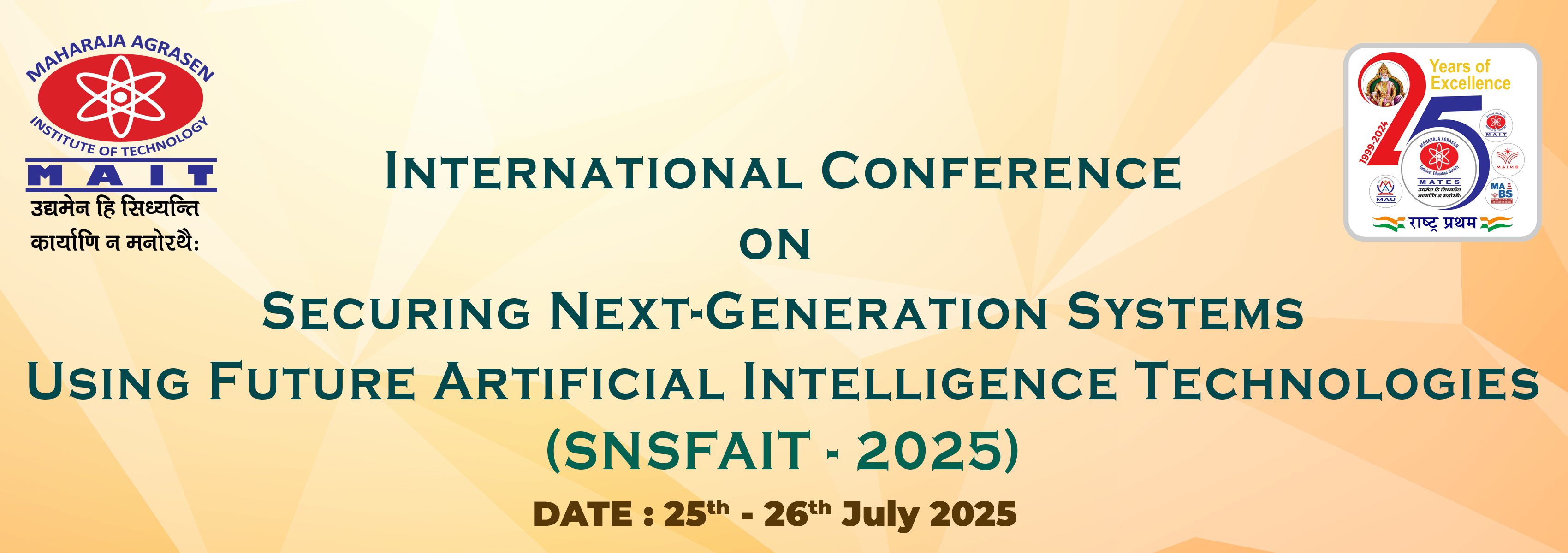
SNSFAIT 2025 proceedings published
About the International Conference
Recent advancements in computing and communication technologies have allowed the development of connected systems that depend primarily on IoT and Edge technologies. However, for the efficient adoption of connected healthcare, the security and privacy of next-generation smart healthcare systems are important challenges. Future technologies such as Blockchain and Machine Learning (ML) are pioneering system security solutions to aid in the effective rollout. In this context, this special section will concentrate on the crucial aspects of IoT security in a connected healthcare environment, which will not only benefit from cutting-edge methodological approaches but also assist in the rapid scalability and improvement of these systems. The objective is to utilise technologies like blockchain in an intelligent city IoT environment for communication, data security and trust management.
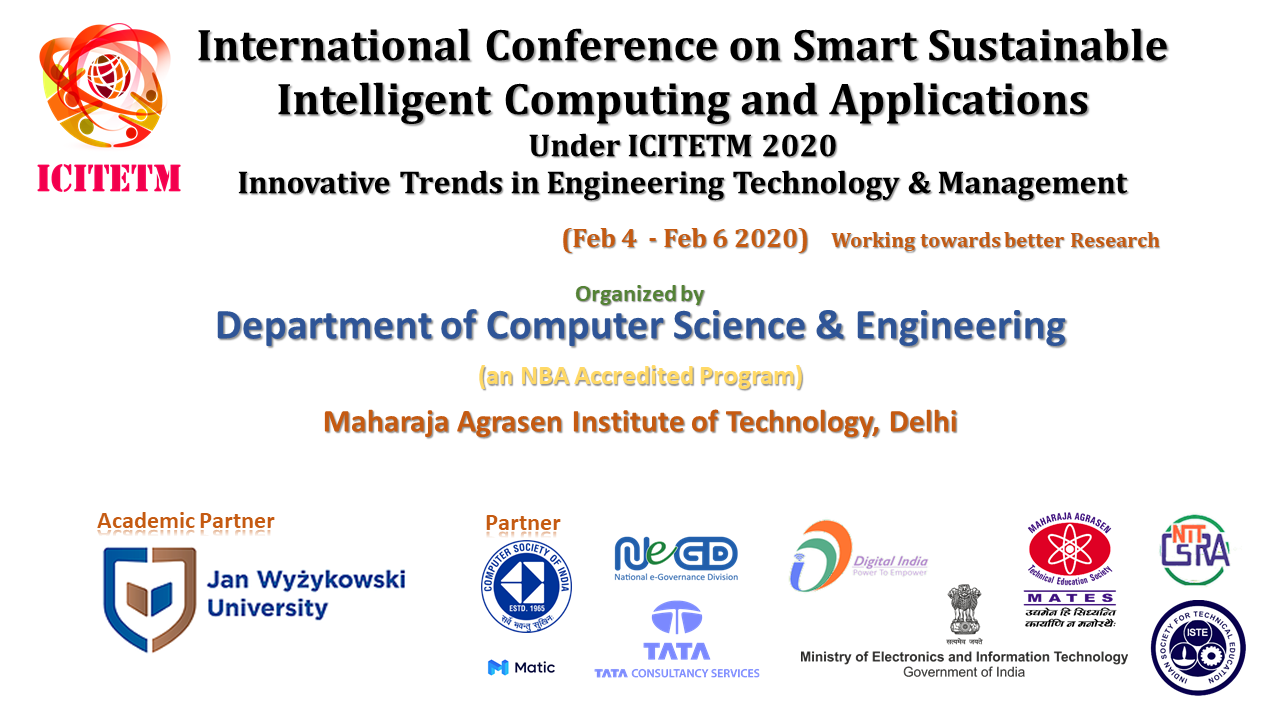
The Second International Conference on Securing Next-Generation Systems using Future Artificial Intelligence Technologies is organised with the objective of bringing together innovative scientists, professors, research scholars, students and industrial experts in the field of Next Generation Systems to a common forum.
Conference Topics
- IoT security and privacy
- Security and trust in smart city and IoT environments leveraging ultra-lightweight cryptography
- QoE/QoS in IoT/edge
- IoT applications benefit from distributed and federated learning.
- Cryptology: Theory and Applications in IoT
- Access management in connected healthcare IoT
- Detection, Protection, and Prevention in a Cyber-threat-Free IoT environment
- Simulation and performance evaluation mechanisms for IoT networks
- 5G innovations for IoTs
- ML-based IoT applications
- Blockchain-based IoT infrastructures
- Blockchain security connecting different IoT protocols
- Digital Twin for IoT systems
- Advancements in Deep Learning Architectures
- Ethical Considerations in AI and Deep Learning
- AI for Healthcare Applications
- Reinforcement Learning in Complex Systems
- AI for Natural Language Processing (NLP)
- Transfer Learning and Few-Shot Learning
- Deep Learning for Computer Vision
- AI and Deep Learning in Finance
- Generative Models in Deep Learning
- AI and Deep Learning for Cybersecurity
- Explainable AI (XAI)
- AI for Edge Computing and IoT
- AI in Autonomous Vehicles
- AI in Smart Manufacturing and Industry 4.0
- Multi-modal Deep Learning
- Quantum Machine Learning
- AI in Environmental Sustainability
- Adversarial Attacks and Defenses in AI
- AI and Deep Learning in Education
- AI for Creativity and Art
Publications
All the accepted papers of SNSFAIT 2025 will be published as proceedings of SNSFAIT by CEUR Workshop Proceedings indexed by Scopus and other leading databases.
For Scopus, check the indexing: https://www.scopus.com/sourceid/21100218356.
|
Track-1 |
Track-2 |
|
International Symposium on Securing Next-Generation Systems using Future Artificial Intelligence Technologies (SNSFAIT) Publication in CEUR Workshop Proceedings |
International Symposium on Intelligent Systems and Deep Learning (ISDL) Publication in CEUR Workshop Proceedings |
|
The scope of the journal includes, but is not limited to, the following topics:- · IoT security and privacy · Security and trust in smart city and IoT environments leveraging ultra-lightweight cryptography · Computer Science and Applications for Defence Modelling & Simulation Domain · QoE/QoS in IoT/edge IoT applications benefit from distributed and federated learning. · Cryptology: Theory and Applications in IoT · Modeling, Simulation, Systems Analysis for Defence Application · Access management in connected healthcare IoT · Detection, Protection, and Prevention in a Cyber-threat-Free IoT environment · Simulation and performance evaluation mechanisms for IoT networks · 5G innovations for IoTs · ML-based IoT applications · Blockchain-based IoT infrastructures · Blockchain security connecting different IoT protocols · Digital Twin for IoT systems · Systems Evaluation Studies · Combat Model Development · Operations Research and Decision Support Techniques |
The scope of the journal includes, but is not limited to, the following topics:- · Advancements in Deep Learning Architectures · Ethical Considerations in AI and Deep Learning · AI for Healthcare Applications · Reinforcement Learning in Complex Systems · AI for Natural Language Processing (NLP) · Transfer Learning and Few-Shot Learning · Deep Learning for Computer Vision · AI and Deep Learning in Finance · Generative Models in Deep Learning · AI and Deep Learning for Cybersecurity · Explainable AI (XAI) · AI for Edge Computing and IoT · AI in Autonomous Vehicles · AI in Smart Manufacturing and Industry 4.0 · Multi-modal Deep Learning · Quantum Machine Learning · AI in Environmental Sustainability · Adversarial Attacks and Defenses in AI · AI and Deep Learning in Education · AI for Creativity and Art |
Important Dates for Paper Submission
Submission Deadline: 9th May 2025
Notification of Accept/Reject: 12th May 2025
Registration Deadline: 13th May 2025
Final Paper Due: 15th May 2025
Previous Speakers of SNSFAIT
 |
 |
 |
 |
 |
 |
 |
|
Prof. Milan Tuba, Singidunum University |
Prof. Manu Malek, Nokia Bell Labs, Stevens Institute of Technology, New Jersey, USA | Prof. Oscar Castillo, Tijuana Institute of Technology, Mexico | Prof. Pravin Chandra, Dean, USICT, GGSIPU, India |
Dr. Korhan Cengiz, College of Information Technology, University of Fujairah, UAE. |
Dr. E.S. Pilli, Malaviya, National Institute of Technology Jaipur, India |
Dr. Kallol Krishna Karmakar, University of Newcastle Australia |
 |
 |
 |
 |
 |
 |
 |
|
Prof. B. K. Panigrahi, IIT, Delhi |
Prof. Vivek Bohara, Head, ECE Department, IIIT, Delhi, India | Dr. Preeti Mishra, Doon University Dehradun, India |
Dr. Ayoub Khan, University of Bisha, Saudi Arabia |
Prof. A.K. Singh, National Institute of Technology Kurukshetra, India |
Dr. Ali Ismail Awad, Lulea University of Technology, Sweden
|
Dr. Mohiuddin Ahmed, Edith Cowan University Joondalup, Australia |
Paper Submission
The Original unpublished Research Papers having minimum length of 10 "standard" pages (1 standard page = 2500 characters) on the topics related to the theme are invited for presentation/publication in the Conference proceedings.
- Authors need to use the uniform CEURART style for the papers. You can choose either the 1-column style as the uniform style for your proceedings. The CEURART styles can be found from the zip: http://ceur-ws.org/Vol-XXX/CEURART.zip Latex: https://www.overleaf.com/latex/templates/template-for-submissions-to-ceur-workshop-proceedings-ceur-ws-dot-org/wqyfdgftmcfw
- All papers must be submitted online via Microsoft CMT (Link: https://cmt3.research.microsoft.com/SNSFAIT2025)
- All submissions will be thoroughly peer-reviewed by experts based on originality, significance and clarity.
- Only papers presenting original content with novel research results or successful innovative applications will be considered for publication in the Conference proceedings.
Author agreement variants
- AUTHOR-AGREEMENT (NTP): Authors shall use this form if they included no copyrighted third party material in their paper text (or accompanying sources, datasets). This is the right variant in most cases.
- AUTHOR-AGREEMENT (TP): Authors shall use this form if they did include copyrighted third party material in their paper or accompanying material. They must then also attach a copy of the permission by the third party to use this material in the signed author agreement!
Plagiarism Policy
- The paper prior to submission should be checked for plagiarism from licensed plagiarism softwares like Turnitin/iAuthenticate etc. The similarity content should not exceed 15% (in any case either self contents or others). Further, you have to strictly implement the following ethical guidelines for publication:
- Any form of self-plagiarism or plagiarism from others' work(s) should not be there in an article.
- If any model / concept / figure / table / data / conclusive comment by any previously published work is used in your article, you should properly cite a reference to the original work.
- Also language of explaining it should not be same as language of the work from which you have adopted it.
- If you are using any copyrighted material, you should acquire prior permission from the copyright holder.
Organizing Committee
|
|
|
International Symposium on Securing Next-Generation Systems using Future Artificial Intelligence Technologies (SNSFAIT) Program Committee (Track-1) |
International Symposium on Intelligent Systems and Deep Learning (ISDL) Program Committee (Track-2) |
|
PC Chair(s) PROF. GEORGE A. TSIHRINTZIS, UNIVERSITY OF PIRAEUS, GREECE PROF. OSCAR CASTILLO, TIJUANA INSTITUTE OF TECHNOLOGY, MEXICO Prof. Manu Malek, STEVENS INSTITUTE OF TECHNOLOGY, NEW JERSEY,USA Dr. Ashish Khanna, Maharaja Agrasen Institute of Technology, India PROF. HONGHAO GAO, SHANGHAI UNIVERSITY - PEOPLE'S REPUBLIC OF CHINA PC Member(s) Prof. Parmanand, Dean, Sharda University, India Dr. Mohamed Mostafa Fouad, Arab Academy for Science and Technology, Egypt Dr. Sanjay Kumar Biswash, Research Scientist INFOCOMM Lab, ICNRTPU, Russia Dr. Alex Norta, Associate Professor, Tallinn University of Technology, Estonia Prof. Kshama Paithankar, SVIM, Indore Prof. Maheshawari Tripathi, IET, Lucknow Prof. Huseyin Irmak, Cankiri Karatekin University, Turkey Prof. Zoltan Horvath, Professor, Kasetsart University Prof. Anil Kumar Ahlawat : KIET Group of Institutes, India Prof. Abhishek Swaroop : Bhagwan Parshuram Institute of Technology, Delhi
|
PC Chair(s) Dr. Utku Kose, Suleyman Demirel University, Isparta, Turkey Dr. Oana Geman, Chalmers University of Technology, Sweden, Prof. Jafar A. Alzubi, Al-Balqa Applied University, Jordan Dr. Aditya Khamparia, Babasaheb Bhimrao Ambedkar University, India PC Member(s) Dr. Dac-Nhuong Le, Haiphong University, Vietnam Dr. Dusanka Boskovic, University of Sarajevo, Sarajevo Dr. D Jude Hemanth, Associate Professor, Karunya University, Coimbatore Dr. Kirti Tyagi, Inha University, Tashkent Dr. Pawan Kumar Tiwari, IET, Lucknow Dr. Rajesh Kumar, CSE Dept, Thapar University, Punjab, India Dr. Amar Mohapatra, Associate Professor, IGDTUW, Delhi, India Dr. PS Rana, Thapar University, Punjab, India Prof. Himani Bansal, JIIT, Noida, India Dr. Brojo Kishore Mishra, CV Raman College of Engineering, Bhubaneshwar
|
Registration Details
It is mandatory to register the accepted paper for the Conference (single registration is required per paper and only one author will be allowed to attend and give a presentation during the Conference )
Registration Structure
|
Fees* Category research |
MAIT Faculties & MAIT Students |
Research Scholar/ Student |
Academician / Industry |
Foreigner Research Scholar/ Student (Outside India) |
Foreigner Academician / Industry (Outside India) |
|
Conference Proceedings (CEUR) Scopus |
Rs. 2950* |
Rs. 4130* |
Rs. 5310* |
$ 200 |
$ 250 |
|
Scopus/ESCI Journals |
Rs. 7080* |
Rs. 12980* |
Rs. 14160* |
$ 400 |
$ 450 |
* Including 18% GST
Payment Transfer Details:
Bank Name: UNION BANK OF INDIA
Bank Address: Sector 22, Rohini Branch, New Delhi-110086, India
Account Name: MAHARAJA AGRASEN INSTITUTE OF TECHNOLOGY
Account Number: 394502010059875
IFSC Code: UBIN0560421
Bank Swift Code: UBININBBSBD
AD Code: 0291679
|
Email: This email address is being protected from spambots. You need JavaScript enabled to view it. |
|
Submission Link: https://cmt3.research.microsoft.com/SNSFAIT2025 |
|
Contact: Dr. Deepak Gupta (9899265660) Mr. Anupam Kumar (9999702583) |
 |
 |
 |